
Blog by Expresscloset |Custom Closet Maker in Vancouver | Last updated: October 2026
Closet shelves sag because the shelf is too long for how thick it is. Shorten the gap between supports, or use a thicker panel, and the sag stops. We have been building custom storage from our Clark Drive shop for Metro Vancouver homeowners since 2005, in East Vancouver character homes with shallow original closets and in Burnaby and North Shore condos where every inch of a reach-in must earn its keep. Nearly every sagging shelf we meet has one of three things wrong: it runs too far with nothing holding up the middle, the panel is too thin for what is sitting on it, or little adjustable pegs are carrying a load that should be built in properly.
Once you know what to look for, you can spot a weak shelf in a showroom or on a quote in about ten seconds. If you have a quote in hand and want a second opinion, you are welcome to book a no-obligation in-home consultation with our design team.
Why Do Closet Shelves Sag in the First Place?
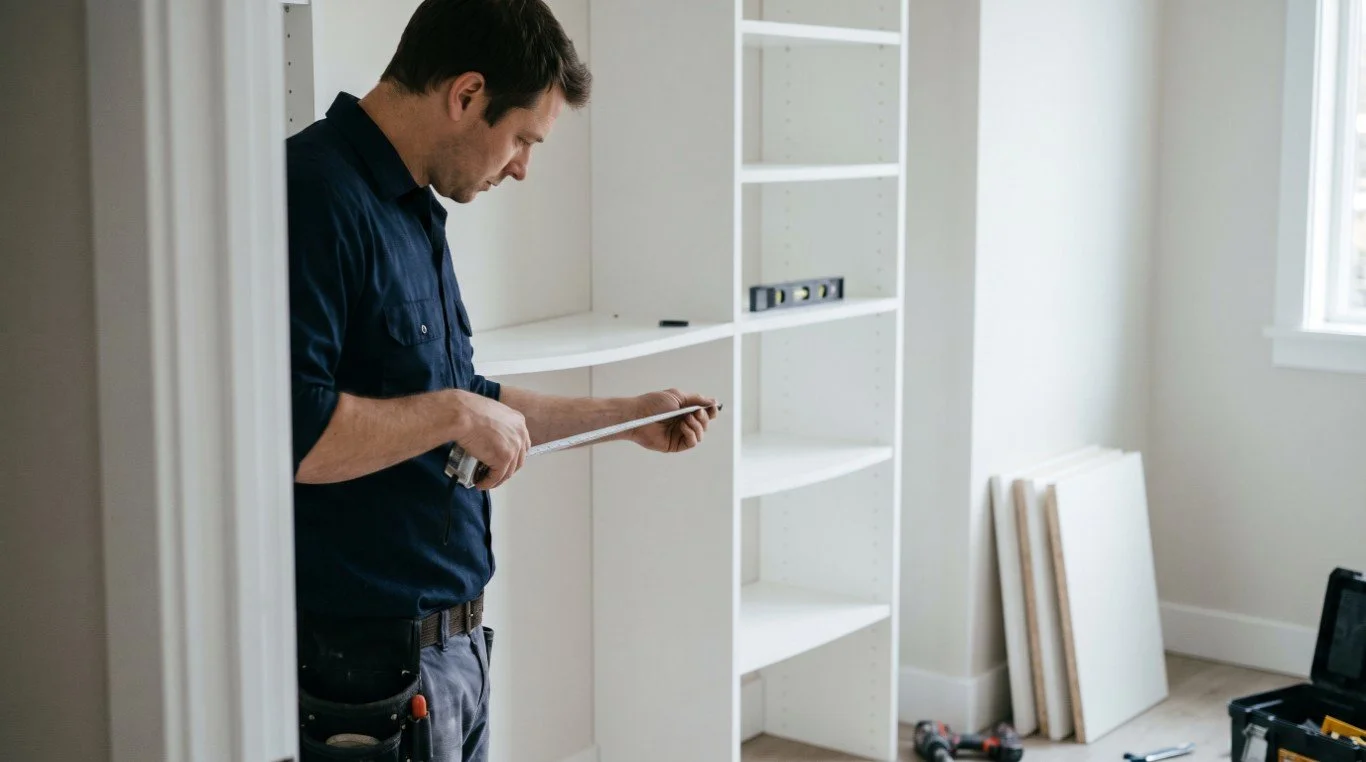
Every shelf is a horizontal beam carrying a distributed load. When that beam is too long, too thin, or poorly supported at its ends and middle, it deflects under weight and eventually takes a permanent set. The sag you see in an older closet is almost never a sudden failure. It is the slow result of physics working against an under-built panel.
Two variables matter most: the unsupported span and the panel thickness. A shelf that performs perfectly at 24 inches wide will bow noticeably at 48 inches even if nothing else changes. That relationship sits underneath every shelving decision we make.
What Panel Thickness Keeps Closet Shelves from Sagging?
Standard melamine-coated particleboard at 5/8 inch is common in budget closet systems. It works for short spans carrying light loads like folded T-shirts or accessories, and very little else. Once you add folded denim, bins, or stacked boxes, that thickness starts to deflect across any span longer than roughly 30 to 32 inches without mid-support.
Three-quarter-inch panels, whether particleboard core or MDF core, carry meaningfully more load across the same span. Plywood at three-quarter inch outperforms both, because its cross-laminated grain resists deflection along the full length rather than only at the centre. Our materials and finishes guide covers how substrates compare, and our post on material mistakes goes deeper on melamine versus plywood specifically.
What Is the Maximum Closet Shelf Span Before Sagging Starts?
Picture a shelf running the full width of a reach-in closet, perhaps 72 inches, supported only at the two side walls. Even a three-quarter-inch panel will deflect visibly over that distance under moderate weight. The answer is not always a thicker panel. Often it is simply breaking the span with a mid-support or a vertical divider.
Quality closet construction keeps unsupported spans under 32 to 36 inches for standard loads, and under 24 inches for heavy items like books, shoe collections in bins, or winter gear. When a quote shows a single shelf running wall to wall across a wide opening with no divider, that is a design worth questioning.
Which Closet Shelf Support Ideas Actually Prevent Sagging?
Mid-supports and vertical dividers make an enormous difference, and not only structurally. A divider at the midpoint of a long shelf cuts the effective span in half, which turns a marginal design into a robust one. The same divider creates useful zones inside the closet, separating hanging sections or defining what goes where.
That support can be a full-height vertical panel, a shorter support column, or a floating bracket anchored to a back wall cleat. Each option trades off differently on visual weight, adjustability, and cost. A well-designed system uses vertical structure on purpose rather than bolting it on later to rescue a thin panel. You are welcome to visit our Clark Drive showroom and see panel thicknesses, hardware, and span examples side by side.
How Does Weight Load Change the Closet Shelf Span You Can Use?
Not all closet contents are equal. A system designed around folded knitwear will struggle with a different category of load. Books and hardcover storage create concentrated, heavy loads that stress both the shelf and its connection points, and folded denim is far denser than most people expect when they stack a season's worth of jeans.
Bins and baskets are a particular challenge, because they invite overfilling and turn a moderate storage item into a concentrated point load. Any zone meant for bins needs a shorter span, a thicker panel, or both. Knowing your real storage habits before you specify a system is one of the most practical steps a Metro Vancouver homeowner can take.
Is Fixed or Adjustable Closet Shelving More Reliable Long-Term?
Fixed shelving, where panels sit in routed dados or fasten mechanically into a structural vertical, is inherently more stable than an adjustable peg-and-pin system. The connection is rigid, the shelf cannot tip, and the load transfers cleanly into the vertical panel. Adjustable systems offer real flexibility, though they depend entirely on hardware quality and on how often the shelves move.
For most closets the best answer is a hybrid. Fix the shelves that will never move, such as the top shelf and any heavy-storage zone, and keep adjustable positions where seasonal reorganization genuinely happens. Our materials and finishes section shows how hardware and panel choices work together.
Frequently Asked Questions
What is the maximum closet shelf span without mid-support?
For standard loads, keep unsupported spans under 32 to 36 inches. For heavy items like books or dense bins, reduce that to 24 inches or less.
Does shelf thickness matter more than span length?
Both matter and they interact directly. Increasing thickness helps, though reducing the span with a mid-support is usually more effective and more cost-efficient.
Can a sagging shelf be fixed without replacing the whole system?
Sometimes. Adding a vertical divider or a wall-mounted cleat and bracket can rescue a marginal shelf, though a badly deflected panel usually needs replacing.
How do I spot a weak shelving design in a showroom?
Look for long horizontal runs with no vertical support, thin panels, and adjustable pegs carrying shelves in heavy-load zones. Ask directly about panel thickness and span lengths.
Is melamine shelving always inferior to plywood?
Not always. Melamine-coated plywood combines a cleanable surface with structural strength. The substrate under the coating matters far more than the coating itself.
Why do closet shelves sag even when they looked fine at installation?
Deflection builds up gradually under sustained load. A shelf that sits level on day one can sag noticeably after months of carrying a full load of clothing or bins.
Ready to Build a Closet That Holds Its Shape? Contact Expresscloset now
If your shelves are already sagging, or you want the specification right before you invest in a new system, we would be glad to help. You are welcome to book a free in-home consultation or browse what we design and install first. There is no pressure and no obligation, only a conversation about what your space actually needs.
Expresscloset 526 Clark Drive, Vancouver, BC V5L 3H7, Phone: (778) 837-1623 Serving Vancouver, Burnaby, North Vancouver, Richmond, and the rest of Metro Vancouver.
